
Optimising the tyres makes the car slower. Unless every engineering department is working from the same picture.
A four-stage method that turns hidden tyre behaviour into vehicle-level performance decisions, giving setup, aero, simulation, and race strategy a shared picture of what the car is actually doing.
Independent Tyre Simulation Specialist, Formula E, IndyCar, NASCAR, WEC, and GT teams.
Former Red Bull Racing Senior Tyre Simulation Engineer, 8+ years
Exclusive F1, F2, and MotoGP tyre consultancy contracts
Proprietary tyre model in active use across professional motorsport
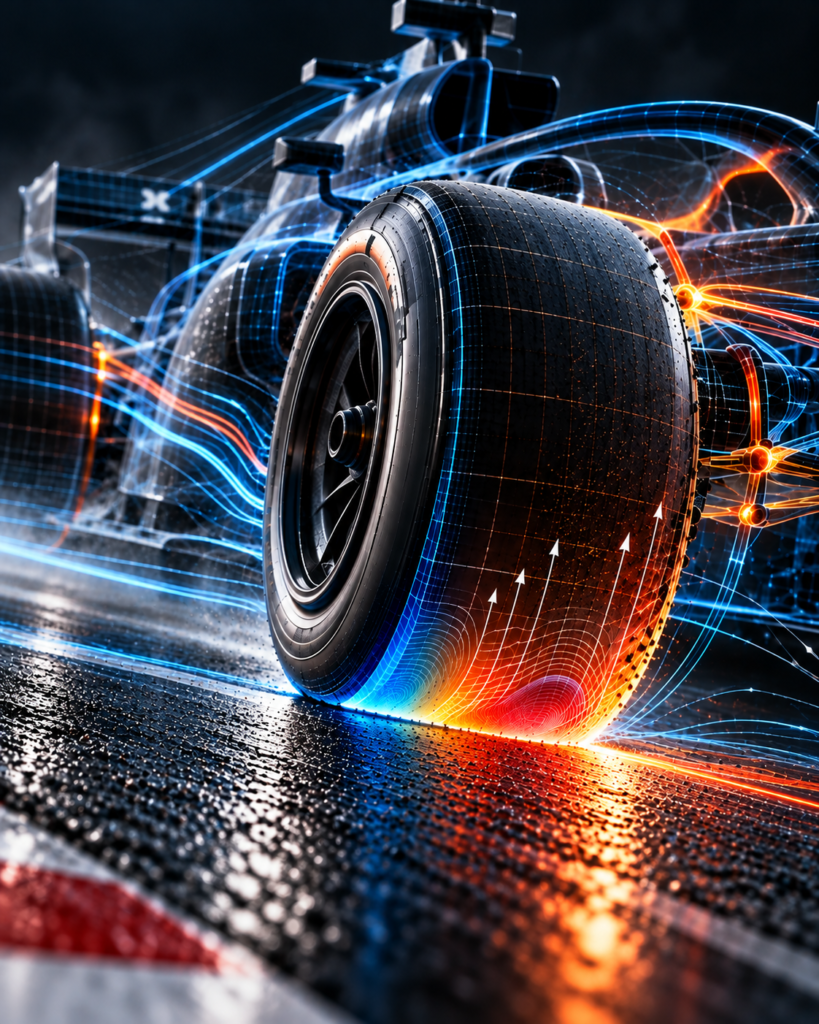
What the tyre is actually showing you
Tyre Vehicle Integration Consulting for Professional Motorsport Teams
The contact patch is the only part of a racing car connected to the track. Every system on the car ultimately expresses itself through four patches of rubber. Which means the tyre isn’t a component. It’s a signal, and most tyre analysis never reads it that way.
None of it tells you what the tyre is revealing about the whole vehicle. In professional motorsport, the gap between what the simulation says and what the car does on track is almost never a tyre model problem in isolation. It’s a tyre-vehicle interaction problem.
Using a proprietary tyre model that reveals hidden tyre states, contact patch temperature distribution, rubber sliding behaviour, interface forces that no track sensor can measure, Laus Engineering builds a whole-vehicle picture from tyre behaviour. This is what we’ve done inside Formula 1. It’s now available to Formula E, IndyCar, NASCAR, WEC, and GT teams.
When teams reach out
Motorsport Performance Consulting, Tyre Simulation and Vehicle Dynamics
The simulation gap
The lap sim doesn't match the car on track. Every department has a theory, no one has the whole picture. The constraint is usually the tyre-vehicle interaction.
The frozen package
The car can't be redesigned, so setup is the only lever left. How well you read tyre behaviour decides where the remaining performance comes from.
The reset baseline
A new tyre specification, a new series or a new car concept. The conditions the model was built on have changed, and it no longer correlates.
The second opinion
The team wants an independent check on its tyre and vehicle picture, from someone without internal bias who has operated at the highest level.
What changed
Motorsport Tyre Simulation Case Studies
MotoGP, a new process for tyre analysis
A MotoGP team working within budget constraints had no process for assessing how their tyres were operating. Laus Engineering established a methodology that became their new default. Every department now works towards the same target, rather than reacting to what the tyre was doing on the day.
WEC, a homologated car back on the pace
A WEC team running a homologated car, design locked by regulations, finished the previous season near the back of the field. After identifying what the tyre behaviour was revealing about the car, every department worked from a shared picture. The team returned to competitive form early the following season.
Work is conducted under full confidentiality across all engagements. Client names and team-specific technical details are not disclosed.
Supporting teams racing in
The thing most tyre analysis gets wrong
Tyre Vehicle Performance Integration Method, Independent Motorsport Consultant
The tyre as signal
The instinct when a car has a tyre problem is to solve the tyre problem. More often, the tyre behaviour is a signal, not the problem itself. Optimising the tyre in isolation can hide the real issue, and sometimes makes the car slower.
Start from the car
Four stages, starting from a data picture of the whole car. Trace the limitation to the tyre-vehicle interaction, use the model to reveal hidden tyre states, then give each engineering department specific direction in its own domain.
One shared picture
No single department inside a team can hold the whole-vehicle picture at once. What Laus Engineering adds is the layer between what the tyre is showing and what each department needs to know about it, in terms it can act on.
How the work runs
Motorsport Tyre Simulation Consultant, Engagement
Engagements run on an annual basis, with a minimum of one year. Understanding how a car and team actually work, then forming hypotheses, implementing them, getting feedback and revising the picture, takes full seasonal cycles. Structure and scope are discussed on the Tyre-Vehicle Assessment call.
Francesco Laus spent eight years and nine months in tyre simulation at Red Bull Racing, rising from Tyre Simulation Engineer to Senior Tyre Simulation Engineer and leading the Tyre Simulation and Performance group. His tyre modelling fed into car design, setup and race strategy, working day to day with aero, suspension, driver-in-the-loop simulation, controls and race engineering. In 2023, the team won 21 of 22 races. Francesco holds a Master’s in Mechanical Engineering from Politecnico di Milano and now works independently as Director of Laus Engineering Limited.
Common questions
Tyre Simulation Consulting FAQ, Independent Motorsport Specialist
What is a Tyre-Vehicle Assessment?
A confidential conversation about your team’s current tyre-vehicle performance challenge, to find out whether there’s an interaction worth investigating further and whether a deeper engagement makes sense.
Why a minimum of one year?
Shorter engagements produce analysis. A year produces understanding. Getting a genuine picture of how a car and team work, and completing enough hypothesis-test-revise cycles, takes a full season.
We have capable tyre engineers internally. Why would we need outside expertise?
The work complements your internal team. It doesn’t replace them. What it adds is the layer between what the tyre behaviour is showing and what your setup, aero, simulation, and race strategy engineers need to know about it. A view no single department can hold from their own seat.
What about confidentiality?
Every engagement starts with a defined scope and confidentiality agreement before any data is shared. All work is conducted under full NDA.
Does your work cover specific series?
Exclusive tyre consultancy contracts are held in Formula 1, Formula 2, and MotoGP. Available to Formula E, IndyCar, NASCAR, WEC, and GT teams.
What does the output actually look like?
A structured report that gives each engineering department specific direction in their own domain. Not a general tyre analysis. A shared reference the whole team works from.
How do I know if this applies to our situation?
If any of these apply, it’s worth a conversation: your lap time model doesn’t correlate with what the car is doing and you can’t explain why; you have a performance ceiling your internal engineering hasn’t been able to close; a regulation or homologation change has made your existing tyre approach obsolete; or you want an independent technical check on your current setup direction.
Schedule your Tyre-Vehicle Assessment Available to Formula E, IndyCar, NASCAR, WEC, and GT teams.